
🔵 Manchester City Formation Breakdown: What Works Best?
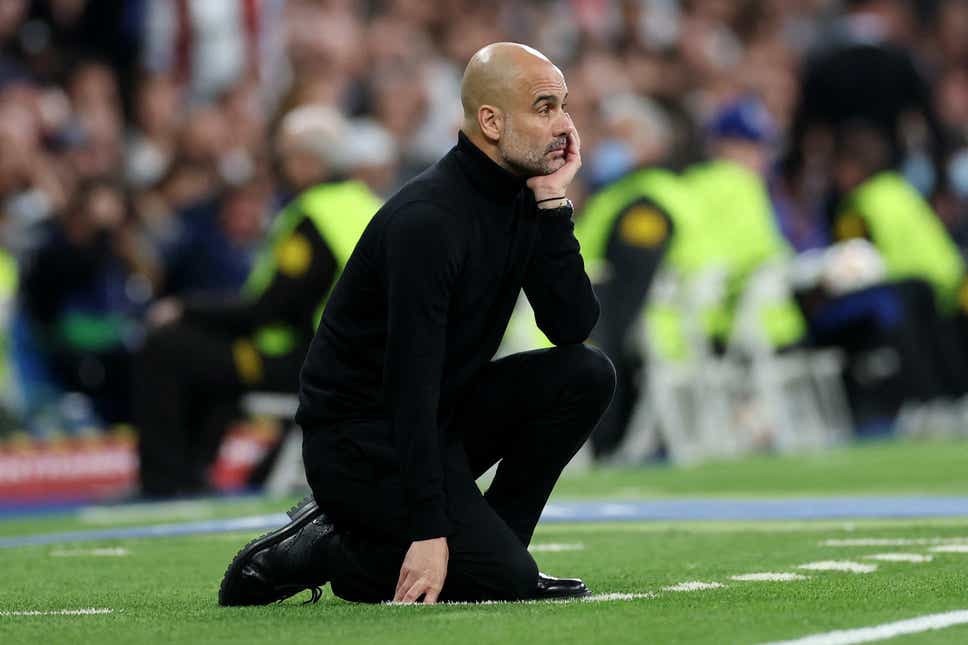
Manchester City’s success under Pep Guardiola isn’t just about star players — it’s rooted in formation flexibility, intelligent patterns of play, and adaptive tactical systems that shift depending on match situations, opposition strategy, and game state. greaterlondontimes.co.uk+1
This guide breaks down the key formations Guardiola’s Citizens use — how they function on paper, in possession, and out of possession. With comparisons, practical examples, and frequently searched FAQs, you’ll understand what works best for Manchester City’s game management.
⚽ Understanding Formations vs Tactical Functions
In football, a formation refers to how players are arranged on the pitch at the start of a game, while tactics are how those players move, interact, and execute strategy throughout a match. A formation like 4‑3‑3 might look basic on paper, but City’s dynamic positional rotations & movement turn it into multiple tactical variants during play. Wikipedia
🔍 Key Manchester City Formations Explained
Below are the most commonly used formations by Manchester City under Guardiola — and when each tends to work best.
🔹 4‑3‑3: The Default Shape
| Feature | Description |
|---|---|
| Structure | Back four, three midfielders, front three |
| Strengths | Balanced, wide attacking options, midfield control |
| Best Used Against | Teams that sit deep or press high weakly |
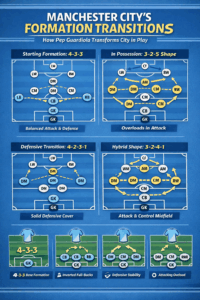
| In Possession Shape | Can turn into 3‑2‑5 with wide fullbacks inverting and midfield pushing high |
The 4‑3‑3 remains Guardiola’s most familiar shape at City, offering width through wingers and numerical control in midfield. It can morph in possession — such as into a 3‑2‑5 shape where full‑backs (or inverted fullbacks) and midfielders create overloads in central areas. Coaches’ Voice
👉 Classic examples of this include City’s usage against top rivals where they dominate possession but still maintain defensive solidity. adiralsport.com
🔹 4‑2‑3‑1: Balance and Penetration
| Feature | Description |
|---|---|
| Structure | Back four, two pivots, three attack midfielders, striker |
| Strengths | Greater defensive cover, creative 10 role |
| Best Used Against | Pressing or mid‑block teams |
| In Possession | Creates horizontal options plus vertical penetration |
The 4‑2‑3‑1 formation — with two holding midfielders — is especially effective against teams that press aggressively or try to shut down central passing channels. This gives City extra screening while still allowing creative outlets to play between defensive lines. metrica-sports.com
🔹 3‑2‑4‑1 / Hybrid Variants
| Formation | Primary Use | Tactical Goal |
|---|---|---|
| 3‑2‑4‑1 | In possession overloads | Maximize width and numbers in attack |
| 3‑2‑5 | Attacking dominance | Stretch opposition backline |
These hybrid formations are often seen when City moves the full‑backs into midfield or centre‑backs advance with ball control — tactics that create midfield superiority and multiple attack angles. Guardiola regularly transitions to a 3‑2‑4‑1 shape during build‑ups to outnumber the opponent’s press. Wikipedia
🔹 Alternative Variants: Positional Shifts
Guardiola also deploys asymmetrical or temporary formations based on match context — for example, variations of 4‑1‑4‑1 or 1‑3‑2‑5 shapes that emphasize build‑up play and numerical superiority. Google Sites
In some matches, players naturally drift to create false nine roles, inverted fullbacks, or midfield diamonds, shifting formation mid‑game while retaining core tactical principles. Pep Guardiola
📊 Formation Comparison: When Each Works Best
| Formation | Midfield Control | Attacking Flexibility | Defensive Security | Press‑Breaking Ability |
|---|---|---|---|---|
| 4‑3‑3 | ⭐⭐⭐⭐ | ⭐⭐⭐⭐ | ⭐⭐⭐ | ⭐⭐⭐⭐ |
| 4‑2‑3‑1 | ⭐⭐⭐⭐⭐ | ⭐⭐⭐ | ⭐⭐⭐⭐ | ⭐⭐⭐⭐ |
| 3‑2‑4‑1 / 3‑2‑5 | ⭐⭐⭐⭐ | ⭐⭐⭐⭐⭐ | ⭐⭐ | ⭐⭐⭐⭐ |
| 4‑1‑4‑1 | ⭐⭐⭐ | ⭐⭐ | ⭐⭐⭐⭐ | ⭐⭐ |
This table highlights that different formations offer distinct advantages — and Guardiola shifts between them based on game strategy, opposition, and desired control. adiralsport.com

🧠 Why These Formations Suit Manchester City
▶ Numerical Superiority
One of Guardiola’s core tactical principles is creating overloads in midfield and attacking zones to outnumber the opponent and control possession. This shows especially in variants of 4‑3‑3 and hybrid 3‑2‑ systems. Total Football Analysis
▶ Press Resistance
City’s formations aren’t static; players rotate roles to beat the press, creating triangles and shifting ball carriers into free spaces. Formations that emphasize short passing and positional play help neutralize opponents’ pressing systems. Total Football Analysis
▶ Positional Play & Overloads
By shifting formations dynamically — such as from 4‑3‑3 to a 3‑2‑5 in possession — City controls both sides of the pitch and stretches defences vertically and horizontally. Football Marketing Agency
📘 Practical Examples From Recent Matches
In key Premier League and Champions League fixtures:
-
City has consistently utilized 4‑3‑3 to dominate possession and manage tempo. adiralsport.com
-
Against teams sitting deep or with strong central pressure, 4‑2‑3‑1 offers balance & creative spacing. metrica-sports.com
-
Hybrid shapes like 3‑2‑4‑1 maximize attacking overloads, especially during build‑up phases. Wikipedia
🏆 Common Tactical Roles Within Formations
| Role | Tactical Function |
|---|---|
| Inverted Full‑Backs | Move into midfield to support possession and create triangles. Google Sites |
| False Nine | Drop striker deep to pull defenders and open spaces. Pep Guardiola |
| Double Pivot | Shield defence while enabling forward transitions. Football Club Menu |
| Wide Options | Stretch opposition and deliver crosses or cutbacks. greaterlondontimes.co.uk |
❓ Frequently Asked Questions (FAQs)
1. What formation does Manchester City use most often?
Manchester City most commonly uses a 4‑3‑3 formation, which provides balance between midfield control and attacking flexibility. greaterlondontimes.co.uk
2. How do formations change in possession for City?
City’s formations are dynamic — for example, 4‑3‑3 can transition to a 3‑2‑5 in possession as full‑backs invert and midfielders push forward to create space and overloads. Google Sites
3. Why does Guardiola sometimes use 4‑2‑3‑1?
The 4‑2‑3‑1 formation offers extra midfield cover and creative options when facing high pressing or compact teams. metrica-sports.com
4. What is a 3‑2‑4‑1 formation?
It’s a flexible shape where City creates numerical superiority through midfield and attack — often emerging during offensive phases to control space and pass options. Wikipedia
5. Does City always stick to one formation in a match?
No — Guardiola adapts during games. Formations can morph depending on whether City is in possession, facing pressure, or managing a lead. Football Marketing Agency
6. How do inverted full‑backs affect formation shape?
Inverted fullbacks move into midfield, essentially shifting shape and allowing midfield overloads — turning a 4‑back line into a mid‑block or deeper central structure. Google Sites
7. Does City use a false nine?
City has used a false nine role historically — where a forward drops deep to link play and destabilize defensive lines. Pep Guardiola
8. Which formation helps defend best?
While all formations have merits, 4‑2‑3‑1** and variants where midfielders cover gaps provide strong defensive security and transition control. Football Club Menu
9. Can City formations adapt to counter‑attacking teams?
Yes — Guardiola’s formations shift to maintain compactness and quick transition defense when facing counter‑attack teams. Football Marketing Agency
10. What formation did City use to win the treble?
During their treble‑winning 2022‑23 campaign, City deployed dynamic variations including 4‑3‑3, 3‑2‑4‑1, and 4‑1‑4‑1 shapes according to match context. Wikipedia
📚 External Resources for Further Reading
Here are 10 authoritative external links to deepen your understanding:
🔚 Conclusion: What Works Best?
Manchester City’s formation success stems from four key principles:
-
⚽ Possession control and numerical superiority
-
🔄 Fluid transitions between formations
-
🧠 Adaptive tactics that respond to opponents
-
🔁 In‑game positional shifts and overloads
Instead of one fixed best formation, City’s tactical strength lies in formation flexibility that keeps opponents unsettled and helps execute Guardiola’s vision of proactive, controlled football.